Tuesday, November 1, 2016

THE KING OF THE POLAR BEARS

By L. Frank Baum

Author of The Wonderful Wizard of Oz, The Boy Fortune Hunters in the Yucatan, Daughters of Destiny, etc.

Originally published in American Fairy Tales, 1901.


The King of the Polar Bears lived among the icebergs in the far north country. He was old and monstrous big; he was wise and friendly to all who knew him. His body was thickly covered with long, white hair that glistened like silver under the rays of the midnight sun. His claws were strong and sharp, that he might walk safely over the smooth ice or grasp and tear the fishes and seals upon which he fed. 

The seals were afraid when he drew near, and tried to avoid him; but the gulls, both white and gray, loved him because he left the remnants of his feasts for them to devour. 

Often his subjects, the polar bears, came to him for advice when ill or in trouble; but they wisely kept away from his hunting grounds, lest they might interfere with his sport and arouse his anger. 

The wolves, who sometimes came as far north as the icebergs, whispered among themselves that the King of the Polar Bears was either a magician or under the protection of a powerful fairy. For no earthly thing seemed able to harm him; he never failed to secure plenty of food, and he grew bigger and stronger day by day and year by year. 

Yet the time came when this monarch of the north met man, and his wisdom failed him.
He came out of his cave among the icebergs one day and saw a boat moving through the strip of water which had been uncovered by the shifting of the summer ice. In the boat were men. 

The great bear had never seen such creatures before, and therefore advanced toward the boat, sniffing the strange scent with aroused curiosity and wondering whether he might take them for friends or foes, food or carrion. 

When the king came near the water's edge a man stood up in the boat and with a queer instrument made a loud "bang!" The polar bear felt a shock; his brain became numb; his thoughts deserted him; his great limbs shook and gave way beneath him and his body fell heavily upon the hard ice. 

That was all he remembered for a time. 

When he awoke he was smarting with pain on every inch of his huge bulk, for the men had cut away his hide with its glorious white hair and carried it with them to a distant ship. 

Above him circled thousands of his friends the gulls, wondering if their benefactor were really dead and it was proper to eat him. But when they saw him raise his head and groan and tremble they knew he still lived, and one of them said to his comrades: 

"The wolves were right. The king is a great magician, for even men cannot kill him. But he suffers for lack of covering. Let us repay his kindness to us by each giving him as many feathers as we can spare." 

This idea pleased the gulls. One after another they plucked with their beaks the softest feathers from under their wings, and, flying down, dropped then gently upon the body of the King of the Polar Bears. 

Then they called to him in a chorus: 

"Courage, friend! Our feathers are as soft and beautiful as your own shaggy hair. They will guard you from the cold winds and warm you while you sleep. Have courage, then, and live!" 

And the King of the Polar Bears had courage to bear his pain and lived and was strong again. 

The feathers grew as they had grown upon the bodies of the birds and covered him as his own hair had done. Mostly they were pure white in color, but some from the gray gulls gave his majesty a slight mottled appearance. 

The rest of that summer and all through the six months of night the king left his icy cavern only to fish or catch seals for food. He felt no shame at his feathery covering, but it was still strange to him, and he avoided meeting any of his brother bears. 

During this period of retirement he thought much of the men who had harmed him, and remembered the way they had made the great "bang!" And he decided it was best to keep away from such fierce creatures. Thus he added to his store of wisdom. 

When the moon fell away from the sky and the sun came to make the icebergs glitter with the gorgeous tintings of the rainbow, two of the polar bears arrived at the king's cavern to ask his advice about the hunting season. But when they saw his great body covered with feathers instead of hair they began to laugh, and one said: 

"Our mighty king has become a bird! Who ever before heard of a feathered polar bear?" 

Then the king gave way to wrath. He advanced upon them with deep growls and stately tread and with one blow of his monstrous paw stretched the mocker lifeless at his feet. 

The other ran away to his fellows and carried the news of the king's strange appearance. The result was a meeting of all the polar bears upon a broad field of ice, where they talked gravely of the remarkable change that had come upon their monarch. 

"He is, in reality, no longer a bear," said one; "nor can he justly be called a bird. But he is half bird and half bear, and so unfitted to remain our king." 

"Then who shall take his place?" asked another. 

"He who can fight the bird-bear and overcome him," answered an aged member of the group. "Only the strongest is fit to rule our race." 

There was silence for a time, but at length a great bear moved to the front and said: 

"I will fight him; I—Woof—the strongest of our race! And I will be King of the Polar Bears." 

The others nodded assent, and dispatched a messenger to the king to say he must fight the great Woof and master him or resign his sovereignty. 

"For a bear with feathers," added the messenger, "is no bear at all, and the king we obey must resemble the rest of us." 

"I wear feathers because it pleases me," growled the king. "Am I not a great magician? But I will fight, nevertheless, and if Woof masters me he shall be king in my stead." 

Then he visited his friends, the gulls, who were even then feasting upon the dead bear, and told them of the coming battle. 

"I shall conquer," he said, proudly. "Yet my people are in the right, for only a hairy one like themselves can hope to command their obedience." 

The queen gull said: 

"I met an eagle yesterday, which had made its escape from a big city of men. And the eagle told me he had seen a monstrous polar bear skin thrown over the back of a carriage that rolled along the street. That skin must have been yours, oh king, and if you wish I will sent an hundred of my gulls to the city to bring it back to you." 

"Let them go!" said the king, gruffly. And the hundred gulls were soon flying rapidly southward. 

For three days they flew straight as an arrow, until they came to scattered houses, to villages, and to cities. Then their search began. 

The gulls were brave, and cunning, and wise. Upon the fourth day they reached the great metropolis, and hovered over the streets until a carriage rolled along with a great white bear robe thrown over the back seat. Then the birds swooped down—the whole hundred of them—and seizing the skin in their beaks flew quickly away. 

They were late. The king's great battle was upon the seventh day, and they must fly swiftly to reach the Polar regions by that time. 

Meanwhile the bird-bear was preparing for his fight. He sharpened his claws in the small crevasses of the ice. He caught a seal and tested his big yellow teeth by crunching its bones between them. And the queen gull set her band to pluming the king bear's feathers until they lay smoothly upon his body. 

But every day they cast anxious glances into the southern sky, watching for the hundred gulls to bring back the king's own skin. 

The seventh day came, and all the Polar bears in that region gathered around the king's cavern. Among them was Woof, strong and confident of his success. 

"The bird-bear's feathers will fly fast enough when I get my claws upon him!" he boasted; and the others laughed and encouraged him. 

The king was disappointed at not having recovered his skin, but he resolved to fight bravely without it. He advanced from the opening of his cavern with a proud and kingly bearing, and when he faced his enemy he gave so terrible a growl that Woof's heart stopped beating for a moment, and he began to realize that a fight with the wise and mighty king of his race was no laughing matter. 

After exchanging one or two heavy blows with his foe Woof's courage returned, and he determined to dishearten his adversary by bluster. 

"Come nearer, bird-bear!" he cried. "Come nearer, that I may pluck your plumage!" 

The defiance filled the king with rage. He ruffled his feathers as a bird does, till he appeared to be twice his actual size, and then he strode forward and struck Woof so powerful a blow that his skull crackled like an egg-shell and he fell prone upon the ground. 

While the assembled bears stood looking with fear and wonder at their fallen champion the sky became darkened. 

An hundred gulls flew down from above and dripped upon the king's body a skin covered with pure white hair that glittered in the sun like silver. 

And behold! the bears saw before them the well-known form of their wise and respected master, and with one accord they bowed their shaggy heads in homage to the mighty King of the Polar Bears.

This story teaches us that true dignity and courage depend not upon outward appearance, but come rather from within; also that brag and bluster are poor weapons to carry into battle.


THE FORGETFUL POET
 
By Ruth Plumly Thompson 
Originally published in the Philadelphia Public Ledger, October 3, 1920.

ThePuzzleCorner

The Forgetful Poet says that when he said he loved 0-M he meant he loved autumn. And the words left out of his verses were ropes, skates, pears and fall; wall and fall.

A pumpkin grows upon a -----
For little boys and -----;
’Tis noted for its yellowness,
Its flavor and its -----.

From pumpkin you can make any number of things: there is a small goblin and something used by the Chinese for incense and by us for mosquitoes, another word for relations and a farm implement.

Why is a pumpkin unlike a hungry little boy?

What Mother Goose boy and Fairy Tale girl are related to the pumpkin?

A Silly Question

Pete Rabbit rushed on Mr. Terry
Turtle, helter skelter.
“Why do you wear a shell?” he asked.
“For -----, for -----!” snapped Terry.
 
 [Answers next time.]

Copyright © 2016 Eric Shanower and David Maxine. All rights reserved.

Saturday, October 15, 2016

OLIVER ELEPHANT’S PICNIC

By Ruth Plumly Thompson
Author of The Silver Princess in Oz, Ozoplaning with the Wizard in Oz, and The Wish Express, etc.

Originally published in the Philadelphia Public Ledger, August 17, 1919.


Once upon a time Oliver Elephant went on a picnic all alone. And I’ll tell you why. He wanted to eat all the sandwiches and cocoanut pies himself. He didn’t even invite Tommy Tapir.

His mother thought, of course, Tommy was going, so she put in enough lunch for both of them, and a bite for any hungry little monkey he might meet, besides.

The basket was pretty heavy, but he was so afraid Tommy or some of the other jungle boys and girls might see him that he hurried until he was all out of breath and tired.

If Tommy had come they would have taken turns with the basket, but as it was Oliver must carry it himself. As soon as he came to a place far enough away for no one to bother him, he sat down under a big tree and fanned himself with his ears.

It was warm and sticky, and all sorts of squidges and midges were flying about. They had a lovely picnic on Oliver Elephant’s back. Of course, if he had been playing tenpins with Tommy he might not have noticed them—and besides half of them would have bitten Tommy Tapir instead of him. But as it was, they all bit him and he got crosser and crosser and crosser.

He whanged all around with his trunk, and to cheer himself up ate three pies on the spot. A little monkey had seen Oliver coming and now he dropped down near him—looking hungrily at the pie. But Oliver just went on chewing and swallowing and swallowing and chewing and never gave him one bite.

The monkey didn’t say anything, but he climbed back up the tree, and after a while a big stick hit Oliver Elephant on the head. Oh, it hurt frightfully! But Oliver never let on.

“This is a fine picnic!” he grumbled to himself, and picking up the rest of his lunch stamped down to the river.

“Maybe I can be alone here!” he blustered angrily, pushing his uncle Abner Elephant’s rowboat out from the bank.

He moved into the middle of the river. Then he ate five sandwiches and two more pies. But somehow they didn’t taste good and somehow he felt heavy and sleepy. So he went to sleep, which is a fine thing to do on a picnic, I must say.

A scraping on the side of the boat awakened Oliver at last.

“Stop!” he screamed “Stop—or you’ll sink the boat!”

What do you think? Johnny Crocodile was biting big pieces out of Uncle Abner’s new rowboat. He wanted the rest of Oliver’s lunch. Oliver hit him with the oar but Johnny didn’t mind oars any more than flies—and, stars!—he bit a great piece out of the bottom, before Oliver could say Jack Robinson.

Oh, if Tommy Tapir had just been invited, everything might still have been saved; he would have rowed while Oliver bailed out the water. But now—well the big little elephant bailed and bailed—and dodged Johnny’s sharp teeth, but he could not row as well. First thing you know the water was up to his waist, next thing it was over his head, and boat and pie, sandwiches and Oliver were all in the river together.

Fortunately Oliver Elephant is a good swimmer. He swam for dear life and climbed up on the bank.

All the rest of the lunch was gone. Johnny had eaten it with great relish and was crunching up the boat for dessert.

“Fine picnic!” he wheezed, miserably. Then, because he wanted to put off going home as long as possible, and because he was cross as a whole bundle of sticks, Oliver went wandering through the jungle without bothering to look where he was going. And so he got lost.

“Would you mind climbing a tree and telling me where I am?” he asked of a monkey who had been watching him for some time.

“Climb a tree yourself, you selfish old thing!” chattered the monkey wickedly. “You ate your pie yourself—didn’t need any help with that, did you? Well find your own way home. I’m busy!”

It was the very same monkey who had wanted a piece of Oliver’s pie. He’d been following him, crossing the river on an old log even, in the hope that Oliver would relent about the pie.

Poor Oliver Elephant. He walked and ran and ran and walked for miles before he found his way back to the river. Then he had to swim across, for his boat was eaten.

Slowly and sorrowfully he limped home and you can imagine how pleased Uncle Abner was when he heard about his boat—and what happened!

“A fine picnic!” wailed Oliver Elephant as he took off his wet clothes and rolled into bed.


THE FORGETFUL POET
 
By Ruth Plumly Thompson
Originally published in the Philadelphia Public Ledger, September 26, 1920.


Puzzle Corner

In answer to his last puzzles the Forgetful Poet says:  “A leaf turns color without moving.”

The words missing from his verses were days and shelf.

Today he said that he just loved 0-M. Now what do you suppose he meant?

And can you piece this patchwork rhyme together?

Jumping ----- and marbles
Roller ----- and ball,
Apples red and sickel -----
Sing a song of -----.

Evenings growing shorter,
Red leaves on the -----,
Hikes and bikes and tramping,
Sing a song of -----.


 [Answers next time.] 

Copyright © 2016 Eric Shanower and David Maxine. All rights reserved.

Saturday, October 1, 2016

BABY PULLED THE PUSSY'S TAIL

By L. Frank Baum 
Author of The Wonderful Wizard of Oz, The Boy Fortune Hunters in the Yucatan, Daughters of Destiny,
etc.


Illustrated by W. W. Denslow

Originally published in Father Goose: His Book, 1899.


THE FORGETFUL POET 

By Ruth Plumly Thompson
Originally published in the Philadelphia Public Ledger, September 19, 1920.

Puzzle Corner

The answers to last week’s puzzles were: Greenland and the Rd Sea. The musical instruments were: Viols, Cornet, organ, harp and horns.

This week he wants to know what turns without moving and what words he has left out of this poem:

SEPTEMBER

September’s nineteen ----- today,
And almost middle-aged.
Already in the Halls of Time
October’s being paged.

They fly so fast, these merry months;
I’ll have to run myself,
Or take a place with solemn face
On Grandpa Time’s top -----?

[Answers next time.]


Copyright © 2016 Eric Shanower and David Maxine. All rights reserved.

Thursday, September 15, 2016

THE STRANGE ADVENTURES OF THE TWO BROTHERS

By Ruth Plumly Thompson
Author of The Cowardly Lion of Oz, Ozoplaning with the Wizard in Oz, and The Wish Express, etc.
 
Originally published in the Philadelphia Public Ledger, February 27, 1916.


Once upon a time two brothers set out from London, to seek their fortunes. They were tall, handsome and healthy, but possessed of no other riches.

They had not gone far before they came to a little girl sitting upon a stile. She was crying bitterly. The first brother, whose name was John, stopped and leaning over asked her what was the matter? “Tut! Tut! What foolishness!” exclaimed the other brother impatiently. “Are we to stop for every sniffling youngster whom we meet? I, for my part, wish to get along in the world and make my fortune. I cannot afford to waste my time on things for which I get no return!” John, the first brother, paid no attention to George, the second brother, but taking out his handkerchief he kindly wiped the little girls tears, and seating himself upon a stone, took her on his lap. Then he pulled out some loose sheets of paper, which he had in his pocket, and began drawing rabbits and bowwows and all sort of funny beasts, so that presently the little girl was clapping her hands with merriment.

At this, George, grumbling something about “Nonsense and Ne’er-do-well!” stamped off down the road by himself. John, meanwhile, drew one thing and another and the more the little maid laughed the happier he felt and the better his pictures became. Just as he was putting the finishing touches to a sketch of the little girl herself, along came a fine carriage with prancing white horses.

“Daddy! Daddy!” cried the little girl, jumping out of John’s lap and running toward the carriage. The white horses were drawn up in a jiffy and out of the carriage sprang a courtly gentleman. And next thing you know, the first brother was rolling gayly down the road in the fine carriage between the little girl and her father, and it wasn’t long before they passed the second brother trudging wearily along on foot. He cried out to his brother, but John and the little girl’s father were so busy talking that they did not hear him. To tell the truth, that gentleman was so grateful for John’s kindness to his little girl, who had been lost, and so delighted with the pictures he had made for her, that he invited him home to dinner on the spot. And from that day fortune smiled upon the first brother. His pictures, drawn to give a little girl pleasure, proved more valuable than he knew. The little girl’s father showed them to all his friends, who immediately commissioned John to paint their portraits, and the portraits of their wives and children, and finally he had so much work and so many friends that he was happy as the day was long.

The second brother tramped along crossly by himself and at nightfall tapped upon the door of a small cottage. The door was opened by a tiny little old lady. George asked her roughly for a night’s lodging. This the little old lady agreed to give him if George cut her wood. He took the ax that she gave him and going sulkily into the yard cut a small quantity of wood. When he carried it into the kitchen the little old lady, who had set out a comfortable supper for him, stared in amazement. “Why have you cut so little?” she asked in surprise. “I’ve cut an amount which I consider equal to my supper and lodging and no more and no less. I am out to make my fortune and cannot cut wood for nothing!” announced George, sitting comfortably down by the fire.

“Indeed!” cried the little old lady, stamping her foot. “Indeed! Then take that for which you have paid!” Throwing a loaf no larger than a man’s fist into his lap, she called her son, who hustled him out of doors in no time. And so things went, from bad to worse, for everywhere the second brother went he tried to bargain and bully folks into giving him more than he earned. All he thought of was getting—of giving he knew nothing.

At last, finding that the world had small use for his talents, he joined a gang of thieves and after many adventures was caught and brought to trial. In those days thieves were hung, and hung he should certainly have been if his brother John had not heard of the proceedings in time. So famous had John become by now that upon his recommendation the wicked brother was released. He generously built his brother a little house upon his own grounds and there the selfish fellow passed the remainder of his days, scolding fate and fortune and everybody but himself for his ill-luck. For he never learned that the way to fortune and to happiness is through giving, not getting.


THE FORGETFUL POET
 
By Ruth Plumly Thompson 
Originally published in the Philadelphia Public Ledger, September 12, 1920.


Puzzle Corner

The school supplies hidden in the Forgetful Poet’s verses were: Ruler, tablets, pen, ink, study and report.

A color will name a land
And a color will name a sea,
And you will find them if you look
In your geography!

What Musical Instruments?

A girl’s name will give you one.

The center of an apple plus something fishermen use will give another.

A name for certain parts of the body will give one used in churches.

A word meaning to dwell continuously on one subject will give another.

Certain animals carry musical instruments on their heads.

And that is enough, don’t you think?

[Answers next time.] 

Copyright © 2016 Eric Shanower and David Maxine. All rights reserved.
Friday, September 9, 2016

THE QUEEN OF QUOK

By L. Frank Baum
Author of The Wonderful Wizard of Oz, The Boy Fortune Hunters in the Yucatan, Daughters of Destiny, etc.

Originally published in American Fairy Tales, 1901.


A king once died, as kings are apt to do, being as liable to shortness of breath as other mortals.

It was high time this king abandoned his earth life, for he had lived in a sadly extravagant manner, and his subjects could spare him without the slightest inconvenience. 

His father had left him a full treasury, both money and jewels being in abundance. But the foolish king just deceased had squandered every penny in riotous living. He had then taxed his subjects until most of them became paupers, and this money vanished in more riotous living. Next he sold all the grand old furniture in the palace; all the silver and gold plate and bric-a-brac; all the rich carpets and furnishings and even his own kingly wardrobe, reserving only a soiled and moth-eaten ermine robe to fold over his threadbare raiment. And he spent the money in further riotous living. 

Don't ask me to explain what riotous living is. I only know, from hearsay, that it is an excellent way to get rid of money. And so this spendthrift king found it.

He now picked all the magnificent jewels from this kingly crown and from the round ball on the top of his scepter, and sold them and spent the money. Riotous living, of course. But at last he was at the end of his resources. He couldn't sell the crown itself, because no one but the king had the right to wear it. Neither could he sell the royal palace, because only the king had the right to live there.

So, finally, he found himself reduced to a bare palace, containing only a big mahogany bedstead that he slept in, a small stool on which he sat to pull off his shoes and the moth-eaten ermine robe. 

In this straight he was reduced to the necessity of borrowing an occasional dime from his chief counselor, with which to buy a ham sandwich. And the chief counselor hadn't many dimes. One who counseled his king so foolishly was likely to ruin his own prospects as well. 

So the king, having nothing more to live for, died suddenly and left a ten-year-old son to inherit the dismantled kingdom, the moth-eaten robe and the jewel-stripped crown. 

No one envied the child, who had scarcely been thought of until he became king himself. Then he was recognized as a personage of some importance, and the politicians and hangers-on, headed by the chief counselor of the kingdom, held a meeting to determine what could be done for him. 

These folk had helped the old king to live riotously while his money lasted, and now they were poor and too proud to work. So they tried to think of a plan that would bring more money into the little king's treasury, where it would be handy for them to help themselves. 

After the meeting was over the chief counselor came to the young king, who was playing peg-top in the courtyard, and said: 

"Your majesty, we have thought of a way to restore your kingdom to its former power and magnificence." 

"All right," replied his majesty, carelessly. "How will you do it?" 

"By marrying you to a lady of great wealth," replied the counselor. 

"Marrying me!" cried the king. "Why, I am only ten years old!" 

"I know; it is to be regretted. But your majesty will grow older, and the affairs of the kingdom demand that you marry a wife." 

"Can't I marry a mother, instead?" asked the poor little king, who had lost his mother when a baby. 

"Certainly not," declared the counselor. "To marry a mother would be illegal; to marry a wife is right and proper." 

"Can't you marry her yourself?" inquired his majesty, aiming his peg-top at the chief counselor's toe, and laughing to see how he jumped to escape it. 

"Let me explain," said the other. "You haven't a penny in the world, but you have a kingdom. There are many rich women who would be glad to give their wealth in exchange for a queen's coronet—even if the king is but a child. So we have decided to advertise that the one who bids the highest shall become the queen of Quok." 

"If I must marry at all," said the king, after a moment's thought, "I prefer to marry Nyana, the armorer's daughter." 

"She is too poor," replied the counselor. 

"Her teeth are pearls, her eyes are amethysts, and her hair is gold," declared the little king. 

"True, your majesty. But consider that your wife's wealth must be used. How would Nyana look after you have pulled her teeth of pearls, plucked out her amethyst eyes and shaved her golden head?" 

The boy shuddered. 

"Have your own way," he said, despairingly. "Only let the lady be as dainty as possible and a good playfellow." 

"We shall do our best," returned the chief counselor, and went away to advertise throughout the neighboring kingdoms for a wife for the boy king of Quok. 

There were so many applicants for the privilege of marrying the little king that it was decided to put him up at auction, in order that the largest possible sum of money should be brought into the kingdom. So, on the day appointed, the ladies gathered at the palace from all the surrounding kingdoms—from Bilkon, Mulgravia, Junkum and even as far away as the republic of Macvelt. 

The chief counselor came to the palace early in the morning and had the king's face washed and his hair combed; and then he padded the inside of the crown with old newspapers to make it small enough to fit his majesty's head. It was a sorry looking crown, having many big and little holes in it where the jewels had once been; and it had been neglected and knocked around until it was quite battered and tarnished. Yet, as the counselor said, it was the king's crown, and it was quite proper he should wear it on the solemn occasion of his auction. 

Like all boys, be they kings or paupers, his majesty had torn and soiled his one suit of clothes, so that they were hardly presentable; and there was no money to buy new ones. Therefore the counselor wound the old ermine robe around the king and sat him upon the stool in the middle of the otherwise empty audience chamber. 

And around him stood all the courtiers and politicians and hangers-on of the kingdom, consisting of such people as were too proud or lazy to work for a living. There was a great number of them, you may be sure, and they made an imposing appearance. 

Then the doors of the audience chamber were thrown open, and the wealthy ladies who aspired to being queen of Quok came trooping in. The king looked them over with much anxiety, and decided they were each and all old enough to be his grandmother, and ugly enough to scare away the crows from the royal cornfields. After which he lost interest in them. 

But the rich ladies never looked at the poor little king squatting upon his stool. They gathered at once about the chief counselor, who acted as auctioneer. 

"How much am I offered for the coronet of the queen of Quok?" asked the counselor, in a loud voice.

"Where is the coronet?" inquired a fussy old lady who had just buried her ninth husband and was worth several millions. 

"There isn't any coronet at present," explained the chief counselor, "but whoever bids highest will have the right to wear one, and she can then buy it." 

"Oh," said the fussy old lady, "I see." Then she added: "I'll bid fourteen dollars." 

"Fourteen thousand dollars!" cried a sour-looking woman who was thin and tall and had wrinkles all over her skin—"like a frosted apple," the king thought. 

The bidding now became fast and furious, and the poverty-stricken courtiers brightened up as the sum began to mount into the millions. 

"He'll bring us a very pretty fortune, after all," whispered one to his comrade, "and then we shall have the pleasure of helping him spend it." 

The king began to be anxious. All the women who looked at all kind-hearted or pleasant had stopped bidding for lack of money, and the slender old dame with the wrinkles seemed determined to get the coronet at any price, and with it the boy husband. This ancient creature finally became so excited that her wig got crosswise of her head and her false teeth kept slipping out, which horrified the little king greatly; but she would not give up. 

At last the chief counselor ended the auction by crying out: 

"Sold to Mary Ann Brodjinsky de la Porkus for three million, nine hundred thousand, six hundred and twenty-four dollars and sixteen cents!" And the sour-looking old woman paid the money in cash and on the spot, which proves this is a fairy story. 

The king was so disturbed at the thought that he must marry this hideous creature that he began to wail and weep; whereupon the woman boxed his ears soundly. But the counselor reproved her for punishing her future husband in public, saying: 

"You are not married yet. Wait until to-morrow, after the wedding takes place. Then you can abuse him as much as you wish. But at present we prefer to have people think this is a love match." 

The poor king slept but little that night, so filled was he with terror of his future wife. Nor could he get the idea out of his head that he preferred to marry the armorer's daughter, who was about his own age. He tossed and tumbled around upon his hard bed until the moonlight came in at the window and lay like a great white sheet upon the bare floor. Finally, in turning over for the hundredth time, his hand struck against a secret spring in the headboard of the big mahogany bedstead, and at once, with a sharp click, a panel flew open. 

The noise caused the king to look up, and, seeing the open panel, he stood upon tiptoe, and, reaching within, drew out a folded paper. It had several leaves fastened together like a book, and upon the first page was written:

"When the king is in trouble
This leaf he must double
And set it on fire
To obtain his desire."


This was not very good poetry, but when the king had spelled it out in the moonlight he was filled with joy. 

"There's no doubt about my being in trouble," he exclaimed; "so I'll burn it at once, and see what happens." 

He tore off the leaf and put the rest of the book in its secret hiding place. Then, folding the paper double, he placed it on the top of his stool, lighted a match and set fire to it. 

It made a horrid smudge for so small a paper, and the king sat on the edge of the bed and watched it eagerly. 

When the smoke cleared away he was surprised to see, sitting upon the stool, a round little man, who, with folded arms and crossed legs, sat calmly facing the king and smoking a black briarwood pipe.
"Well, here I am," said he. 

"So I see," replied the little king. "But how did you get here?" 

"Didn't you burn the paper?" demanded the round man, by way of answer. 

"Yes, I did," acknowledged the king. 

"Then you are in trouble, and I've come to help you out of it. I'm the Slave of the Royal Bedstead." 

"Oh!" said the king. "I didn't know there was one." 

"Neither did your father, or he would not have been so foolish as to sell everything he had for money. By the way, it's lucky for you he did not sell this bedstead. Now, then, what do you want?" 

"I'm not sure what I want," replied the king; "but I know what I don't want, and that is the old woman who is going to marry me." 

"That's easy enough," said the Slave of the Royal Bedstead. "All you need do is to return her the money she paid the chief counselor and declare the match off. Don't be afraid. You are the king, and your word is law." 

"To be sure," said the majesty. "But I am in great need of money. How am I going to live if the chief counselor returns to Mary Ann Brodjinski her millions?" 

"Phoo! that's easy enough," again answered the man, and, putting his hand in his pocket, he drew out and tossed to the king an old-fashioned leather purse. "Keep that with you," said he, "and you will always be rich, for you can take out of the purse as many twenty-five-cent silver pieces as you wish, one at a time. No matter how often you take one out, another will instantly appear in its place within the purse." 

"Thank you," said the king, gratefully. "You have rendered me a rare favor; for now I shall have money for all my needs and will not be obliged to marry anyone. Thank you a thousand times!" 

"Don't mention it," answered the other, puffing his pipe slowly and watching the smoke curl into the moonlight. "Such things are easy to me. Is that all you want?" 

"All I can think of just now," returned the king. 

"Then, please close that secret panel in the bedstead," said the man; "the other leaves of the book may be of use to you some time." 

The boy stood upon the bed as before and, reaching up, closed the opening so that no one else could discover it. Then he turned to face his visitor, but the Slave of the Royal Bedstead had disappeared.
"I expected that," said his majesty; "yet I am sorry he did not wait to say good-by." 

With a lightened heart and a sense of great relief the boy king placed the leathern purse underneath his pillow, and climbing into bed again slept soundly until morning. 

When the sun rose his majesty rose also, refreshed and comforted, and the first thing he did was to send for the chief counselor. 

That mighty personage arrived looking glum and unhappy, but the boy was too full of his own good fortune to notice it. Said he: 

"I have decided not to marry anyone, for I have just come into a fortune of my own. Therefore I command you return to that old woman the money she has paid you for the right to wear the coronet of the queen of Quok. And make public declaration that the wedding will not take place." 

Hearing this the counselor began to tremble, for he saw the young king had decided to reign in earnest; and he looked so guilty that his majesty inquired: 

"Well! what is the matter now?" 

"Sire," replied the wretch, in a shaking voice, "I cannot return the woman her money, for I have lost it!" 

"Lost it!" cried the king, in mingled astonishment and anger. 

"Even so, your majesty. On my way home from the auction last night I stopped at the drug store to get some potash lozenges for my throat, which was dry and hoarse with so much loud talking; and your majesty will admit it was through my efforts the woman was induced to pay so great a price. Well, going into the drug store I carelessly left the package of money lying on the seat of my carriage, and when I came out again it was gone. Nor was the thief anywhere to be seen." 

"Did you call the police?" asked the king. 

"Yes, I called; but they were all on the next block, and although they have promised to search for the robber I have little hope they will ever find him." 

The king sighed. 

"What shall we do now?" he asked. 

"I fear you must marry Mary Ann Brodjinski," answered the chief counselor; "unless, indeed, you order the executioner to cut her head off." 

"That would be wrong," declared the king. "The woman must not be harmed. And it is just that we return her money, for I will not marry her under any circumstances." 

"Is that private fortune you mentioned large enough to repay her?" asked the counselor. 

"Why, yes," said the king, thoughtfully, "but it will take some time to do it, and that shall be your task. Call the woman here." 

The counselor went in search of Mary Ann, who, when she heard she was not to become a queen, but would receive her money back, flew into a violent passion and boxed the chief counselor's ears so viciously that they stung for nearly an hour. But she followed him into the king's audience chamber, where she demanded her money in a loud voice, claiming as well the interest due upon it over night. 

"The counselor has lost your money," said the boy king, "but he shall pay you every penny out of my own private purse. I fear, however, you will be obliged to take it in small change." 

"That will not matter," she said, scowling upon the counselor as if she longed to reach his ears again; "I don't care how small the change is so long as I get every penny that belongs to me, and the interest. Where is it?" 

"Here," answered the king, handing the counselor the leathern purse. "It is all in silver quarters, and they must be taken from the purse one at a time; but there will be plenty to pay your demands, and to spare." 

So, there being no chairs, the counselor sat down upon the floor in one corner and began counting out silver twenty-five-cent pieces from the purse, one by one. And the old woman sat upon the floor opposite him and took each piece of money from his hand. 

It was a large sum: three million, nine hundred thousand, six hundred and twenty-four dollars and sixteen cents. And it takes four times as many twenty-five-cent pieces as it would dollars to make up the amount. 

The king left them sitting there and went to school, and often thereafter he came to the counselor and interrupted him long enough to get from the purse what money he needed to reign in a proper and dignified manner. This somewhat delayed the counting, but as it was a long job, anyway, that did not matter much. 

The king grew to manhood and married the pretty daughter of the armorer, and they now have two lovely children of their own. Once in awhile they go into the big audience chamber of the palace and let the little ones watch the aged, hoary-headed counselor count out silver twenty-five-cent pieces to a withered old woman, who watched his every movement to see that he does not cheat her. 

It is a big sum, three million, nine hundred thousand, six hundred and twenty-four dollars and sixteen cents in twenty-five-cent pieces. 

But this is how the counselor was punished for being so careless with the woman's money. And this is how Mary Ann Brodjinski de la Porkus was also punished for wishing to marry a ten-year-old king in order that she might wear the coronet of the queen of Quok. 


THE FORGETFUL POET 
By Ruth Plumly Thompson 
Originally published in the Philadelphia Public Ledger, September 5, 1920.

The Puzzle Corner

Although the Forgetful Poet is too old to go to school himself, he evidently has it on his mind. But before I put in his new puzzles I’ll just answer his last ones.

“Lead pencils are like little girls,” he says, “because they are always losing their rubbers.” The youngest folks in the shoe closet are the kid slippers, and the queer Crustacean lived in the Caribbean, and the other left-out word was know.

SCHOOL SUPPLIES

Now just put on your thinking caps
And find these school supplies—
Another name for sovereign
Will give one, I surmise!

A form that medicine comes in
Will give some more, I think.
A small inclosure still another—
Don’t forget the -----?

A room will describe
What each scholar must do,
And the noise from a gun
What the teacher gives you!

School’s not so worse—
Just you take it from me.
There’s a lot of old friends
I’m just crazy to see!

[Answers next time.]


Copyright © 2016 Eric Shanower and David Maxine. All rights reserved.
Monday, August 15, 2016

THE TALE OF A PINK FLAMINGO

By Ruth Plumly Thompson
Author of The Lost King of Oz, Ozoplaning with the Wizard in Oz, and The Wish Express, etc.

Originally published in the Philadelphia Public Ledger, June 22, 1919.


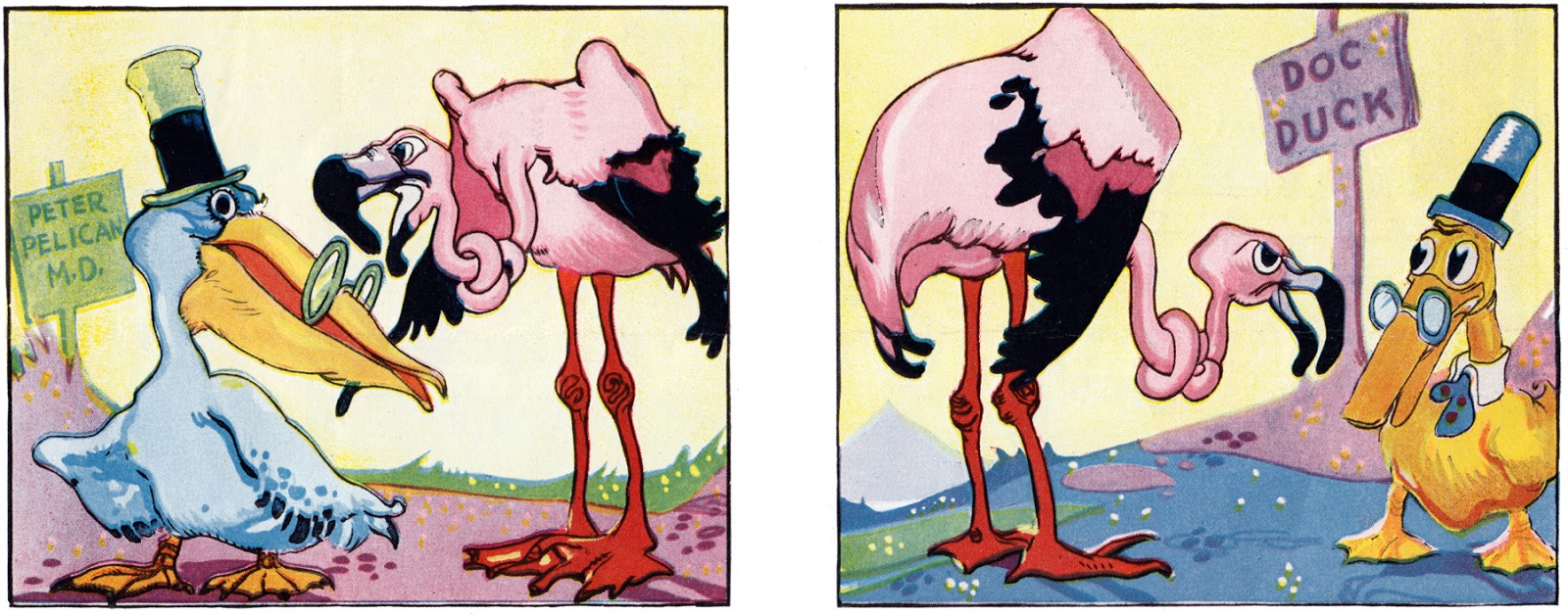
Here is a story that’s true as true
Of a pink flamingo who felt dark blue!
For this pink flamingo bird had got
His long, long neck in a hard, hard knot.

The bad little fishes splashed in a row
And watched the pink flamingo GO—
“We’re safe as long as that knot stays tied,
You cannot eat us now—old dear,” they cried.


Not only blue he felt—but hollow,
With a knot tied in his neck—how could he swallow?
So he picked up his long, long legs—and ran
To his uncle Peter Pelican!

The flamingo heard and muttered as he ran,
“If any one can help me Peter Pelican CAN!”
Peter Pelican tried—but he couldn’t—worse luck,
So he sent him off to a Doctor Duck.


Doctor Duck looked close—“Sir, I diagnose
Your case as a sailor’s knot—I suppose
A sailor must untie it!” Off the pink bird ran
Till at last he came up with a sailor man—

He made a bow and he said a lot
In flamingo-ese—about the knot.
Tho’ the sailor didn’t quite understand the lingo,
He untied the knot for the pink flamingo!
                  (And that’s about all.)


THE FORGETFUL POET
 
By Ruth Plumly Thompson 
Originally published in the Philadelphia Public Ledger, August 29, 1920.


Puzzles Out of the Jungle Box

The warmer the weather becomes the more nonsense the Forgetful Poet seems to think up. He said no wonder, with a pen that was out of its mind, and when I asked him what he meant he said: “It was, from constant doses of ink, quite dippy.”

Then he wanted to know why there was always a jam on the pantry shelf, and when I threatened him with the letter opener he retired chuckling. And when he had gone I found these riddles on my desk:

Why are lead pencils like little girls?

Who are the youngest people in the shoe closet?

Can you finish these verses:

There once was a queer Crustacean,
Who lived in the blue -----?
He swam to and fro and for all that I -----
He made verses in ancient Chaldean!

Last week’s answers were: Cotton wood tree, red wood, ash, beach, peach and locusts.

[Answers next time.]


Copyright © 2016 Eric Shanower and David Maxine. All rights reserved.